what is the most effective way to kill yourself

A suicide method is whatsoever means past which a person chooses to end their life. Suicide attempts do not always upshot in death, and a nonfatal suicide attempt can leave the person with serious physical injuries, long-term wellness bug, and encephalon damage.[i]
Worldwide, iii suicide methods predominate with the pattern varying in different countries. These are hanging, poisoning by pesticides, and firearms.[2] Other common suicide methods include jumping from a great height, drug overdoses, and drowning.[3] [4]
Suicides are often impulse decisions that may be preventable by removing the means.[5] Making common suicide methods less attainable leads to an overall reduction in the number of suicides.[6] [7] Some ways to practise this include restricting access to pesticides, firearms, and known-used drugs. Other of import measures are the introduction of policies that address the misuse of alcohol and the handling of mental disorders.[eight] Gun-control measures in a number of countries have seen a reduction in suicides and other gun-related deaths.[nine]
Purpose of study
The study of suicide methods aims to place those commonly used, and the groups at adventure of suicide; making methods less attainable may be useful in suicide prevention.[half-dozen] [v] [10] Limiting the availability of means such as pesticides and firearms is recommended by a World Health Study on suicide and its prevention. The early on identification of mental disorders and substance corruption disorders, follow-up care for those who have attempted suicide, and responsible reporting by the media are all seen to be key in reducing the number of deaths by suicide.[11] National suicide prevention strategies are too advocated using a comprehensive and coordinated response to suicide prevention. This needs to include the registration and monitoring of suicides and attempted suicide, breaking figures down past age, sex, and method.[11]
Such information allows public health resources to focus on the problems that are relevant in a particular place, or for a given population or subpopulation.[12] For example, if firearms are used in a pregnant number of suicides in one place, then public health policies there could focus on gun safety, such as keeping guns locked abroad, and the key inaccessible to at-chance family members. If young people are institute to be at increased take chances of suicide by overdosing on particular medications, then an alternative course of medication may be prescribed instead, a safety plan and monitoring of medication can be put in place, and parents can exist educated almost how to prevent the hoarding of medication for a future suicide endeavour.[10]
Media reporting
Media reporting of the methods used in suicides is "strongly discouraged" by the World Health Arrangement, government wellness agencies, universities, and the Associated Press among others.[13] Detailed descriptions of suicides or the personal characteristics of the person who died contribute to copycat suicides (suicide contagion).[fourteen] [15] Dramatic or inappropriate descriptions of individual suicides past mass media has been linked specifically to copycat suicides among teenagers.[xv] Writing for the New Yorker most celebrity suicides, Andrew Solomon wrote that "You who are reading this are at statistically increased chance of suicide right at present."[xvi] In one written report, changes in how news outlets reported suicide reduced suicides past a item method.[15]
Media reporting guidelines also use to "online content including citizen-generated media coverage". The Recommendations for Reporting on Suicide, created by journalists, suicide prevention groups, and internet condom non-profit organizations, encourage linking to resources such as a list of suicide crisis lines and information about hazard factors for suicide, and reporting on suicide as a multi-faceted, treatable health issue.[17]
Method restriction
Method restriction, also called lethal means reduction, is an effective style to reduce the number of suicide deaths in the short and medium term.[18] Method restriction is considered a best practice supported past "compelling" prove.[15] Some of these actions, such as installing barriers on bridges and reducing the toxicity in gas, require activeness past governments, industries, or public utilities. At the individual level, method restriction can exist every bit simple every bit asking a trusted friend or family fellow member to store firearms until the crisis has passed.[19] [xx] Choosing not to restrict access to suicide methods is considered unethical.[15]
Method restriction is effective and prevents suicides.[15] It has the largest effect on overall suicide rates when the method existence restricted is mutual and no direct substitution is bachelor. [15] If the method beingness restricted is uncommon, or if a substitute is readily available, and then information technology may be effective in individual cases but not produce a large-scale reduction in the number of deaths in a land.[xv]
Method commutation is the process of choosing a different suicide method when the first-pick method is inaccessible.[five] In many cases, when the showtime-choice method is restricted, the person does not endeavour to find a substitute.[15] Method substitution has been measured over the course of decades, so when a common method is restricted (for example, by making domestic gas less toxic), overall suicide rates may be suppressed for many years.[5] [xv] If the first-pick suicide method is inaccessible, a method substitution may be fabricated which may be less lethal, disposed to outcome in fewer fatal suicide attempts.[5]
In an example of the curb cut effect, changes unrelated to suicide have also functioned as suicide method restrictions.[xv] Examples of this include changes to marshal train doors with platforms, switching from coal gas to natural gas in homes, and gun control laws, all of which have reduced suicides despite being intended for a different purpose.[15]
List
Suffocation
Suffocation, as a nomenclature of suicide method, includes strangulation and hanging.[21] [22]
Suicide by suffocation involves restricting animate or the amount of oxygen taken in, causing asphyxia and somewhen hypoxia. This may involve the use of a plastic suicide bag.[23] It is not possible to die simply by holding the breath, since a reflex causes the respiratory muscles to contract, forcing an in-jiff, and the re-institution of a normal breathing rhythm.[24] Therefore, inhaling an inert gas such every bit helium, nitrogen, and argon, or a toxic gas such as carbon monoxide, is used to bring virtually unconsciousness.[25] [26] As of 2010[update], organizations supporting a right to dice used death by helium inhalation more ofttimes than drug overdoses, largely owing to its reliability.[27]
Suicide by strangulation is self-strangulation that may involve the partial suspension of the body rather than the full suspension used in hanging. Cocky-strangulation involves tightening a ligature around the neck. This compresses the carotid arteries, preventing the supply of oxygen to the encephalon, resulting in unconsciousness and decease.
Hanging
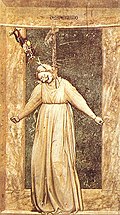
Hanging is a common method of suicide.[22] [21] Hanging involves the utilise of a ligature such as a rope or cord attached to an anchor bespeak with the other terminate used to grade a noose placed around the neck. The cause of expiry will either be due to strangulation or a broken neck. Almost half of attempted suicides past hanging result in decease.[4] People who favor this method are usually unaware that it is often a "wearisome, painful, and messy method that needed technical knowledge".[28]
Hanging is the prevalent ways of suicide in impoverished pre-industrial societies, and is more common in rural areas than in urban areas.[29] It is also a common means of suicide in situations where other materials are not readily available, such as in prisons.
Hanging was the about common method in traditional Chinese culture,[30] equally it was believed that the rage involved in such a decease permitted the person's spirit to haunt and torment survivors.[31] [32] In the Chinese culture, suicide by hanging was used as an act of revenge by women[33] and of defiance by powerless officials, who used information technology every bit a "final, but unequivocal, style of standing still confronting and higher up oppressive authorities".[xxx] Chinese people would frequently approach the deed ceremonially, including the use of proper attire.[30]
Poisoning
Suicide past poisoning, too chosen self-poisoning, is usually classed as a drug overdose when drugs such equally painkillers or recreational drugs are used. The use of pesticides to self-toxicant is the most mutual method used in some countries.[2] Inhalation of poisonous gases such as carbon monoxide may also exist a crusade of death by suicide. Poisoning through the ways of toxic plants is ordinarily slow and painful.[34] [ amend source needed ] The mass suicide of members of a cult led by Jim Jones in 1978 resulted from poisoning ("Drinking the Kool-Assist").[35] [ better source needed ]
Pesticide
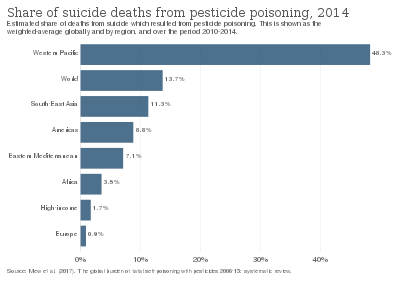
Share of suicide deaths from pesticide poisoning[36]
As of 2006[update], worldwide, around 30% of suicides were from pesticide poisonings.[37] The use of this method varies markedly in dissimilar areas of the world, from 0.9% in Europe to virtually 50% in the Pacific region.[36] In the The states, pesticide poisoning is used in nearly 12 suicides per year.[38] Poisoning past subcontract chemicals is very mutual among women in rural China, and is regarded as a major social trouble in the land.[39]
Method restriction has been an effective mode to reduce suicide by poisoning in many countries. In Republic of finland, limiting access to parathion in the 1960s resulted in a rapid decline in both poisoning-related suicides and full suicide deaths for several years, and a slower reject in subsequent years.[40] In Sri Lanka, both suicide by pesticide and total suicides declined after starting time toxicity class I and afterward class Ii endosulfan were banned.[41] Overall suicide deaths were cut past seventy%, with 93,000 lives saved over 20 years equally a outcome of banning these pesticides.[2] In Korea, banning a single pesticide, paraquat, halved the number of suicides past pesticide poisoning[2] and reduced the full number of suicides in that country.[forty]
Drug overdose
A drug overdose involves taking a dose of a drug that exceeds safe levels. In the Britain (England and Wales) until 2013, a drug overdose was the nigh common suicide method in females.[42] In 2019 in males the percentage is sixteen%. Self-poisoning accounts for the highest number of non-fatal suicide attempts. Overdose attempts using painkillers are among the most common, due to their easy availability over-the-counter.[43] Paracetamol is the most widely used analgesic worldwide and is ordinarily used in overdose attempts.[44] Paracetamol poisoning is a common cause of acute liver failure.[45] [44] In the United States nigh sixty% of suicide attempts and 14% of suicide deaths involve drug overdoses.[iv] The risk of death in suicide attempts involving overdose is about 2%.[4] [ verification needed ]
A drug overdose is often the first-pick method of members of right-to-dice organizations. A poll among members of Exit International suggested that 89% would prefer to take a pill, rather than use a plastic exit pocketbook, a carbon monoxide generator, or slow euthanasia.[46] [47]
Carbon monoxide
A particular type of poisoning involves the inhalation of high levels of carbon monoxide (CO). Death normally occurs through hypoxia. Carbon monoxide is used because it is hands available. A nonfatal endeavour can outcome in memory loss and other symptoms.[48] [ self-published source? ] [49]
Carbon monoxide is a colorless and odorless gas, so its presence cannot exist detected by sight or aroma. Information technology acts by binding preferentially to the hemoglobin in the bloodstream, displacing oxygen molecules and progressively deoxygenating the claret, eventually resulting in the failure of cellular respiration and death. Carbon monoxide is extremely dangerous to bystanders and people who may notice the trunk, and then "Right to Die" advocates similar Philip Nitschke recommend confronting it.[50] [ self-published source? ]
Before air quality regulations and catalytic converters, suicide by carbon monoxide poisoning was frequently accomplished by running a machine'due south engine in an enclosed space such equally a garage, or past redirecting a running car'due south exhaust back inside the motel with a hose. Motor machine exhaust may take independent up to 25% carbon monoxide. Catalytic converters constitute on all modern automobiles eliminate over 99% of carbon monoxide produced.[51] Equally a farther complication, the corporeality of unburned gasoline in emissions tin make exhaust unbearable to breathe well before a person loses consciousness.
Charcoal-burning suicide induces death from carbon monoxide poisoning. Originally used in Hong Kong, it spread to Japan,[52] where small-scale charcoal-burning heaters (hibachi) or stoves (shichirin) take been used in a sealed room. Past 2001, this method accounted for 25% of deaths from suicide in Japan.[53] It has become the second almost mutual suicide method in Hong Kong and is a growing trend in other countries.[52] Nonfatal attempts can upshot in severe brain damage due to cerebral anoxia.
Other toxins
Detergent-related suicide involves mixing household chemicals to produce poisonous gases.[54] [ better source needed ] At the stop of the 19th century in Uk, there were more suicides from carbolic acid (a disinfectant) than from any other poison since there was no restriction on its sale. Braxton Hicks and other coroners chosen for its sale to be prohibited in 1893.[55] [56]
The suicide rates past domestic gas fell from 1960 to 1980, equally changes were made to the formula to make information technology less lethal.[5] [57]
Shooting

Comparing of gun-related suicide rates to non-gun-related suicide rates in high-income OECD countries, 2010, countries in graph ordered by total suicides. The US was the only OECD country in which gun suicide rates exceeded not-gun suicide rates.[58]
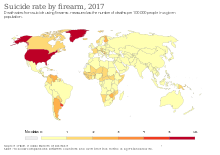
Suicide rate by firearm[59]
In the Us suicide by firearm is the well-nigh lethal method of suicide resulting in 90% of suicide fatalities,[4] and is thus the leading cause of decease by suicide as of 2017.[sixty] Worldwide, firearm prevalence in suicides varies widely, depending on the acceptance and availability of firearms in a culture. The apply of firearms in suicides ranges from less than 10% in Australia[61] to 50.v% in the U.S., where it is the most common method of suicide.[62]
By and large, the bullet will exist aimed at point-blank range. Surviving a cocky-inflicted gunshot may outcome in severe chronic pain besides equally reduced cerebral abilities and motor function, subdural hematoma, strange bodies in the caput, pneumocephalus and cerebrospinal fluid leaks. For temporal bone directed bullets, temporal lobe abscess, meningitis, aphasia, hemianopsia, and hemiplegia are mutual late intracranial complications. As many as fifty% of people who survive gunshot wounds directed at the temporal bone endure facial nerve damage, usually due to a severed nerve.[63]
Gun command
Reducing access to guns at a population level decreases the risk of suicide by firearms.[64] [65] [66]
Fewer people die from suicide overall in places with stricter laws regulating the use, buy, and trading of firearms.[67] [68] Suicide run a risk goes up when firearms are more bachelor.[69] [70] [71]
Gun control is a primary method of reducing suicide by people who alive in a dwelling with guns. Prevention measures include simple actions such equally locking all firearms in a gun safe or installing gun locks.[twenty] Some stores that sell guns provide temporary storage as a service; in other cases, a trusted friend or family member will offer to store the guns until the crisis has passed.[19] [20] When a person is going through a crisis, red flag laws in some places allow family members to petition the courts to have firearms temporarily removed and stored elsewhere.
More firearms are involved in suicide than are involved in homicides in the The states. A 1999 study of California and gun mortality found that a person is more than likely to die by suicide if they have purchased a firearm, with a measurable increment of suicide by firearm beginning at most a week subsequently the purchase and continuing for half-dozen years or more.[72]
The United States has both the highest number of suicides and firearms in circulation in a developed country, and when gun ownership rises and then as well does suicide involving the utilize of a firearm.[73] [74] A 2004 study by the National Academy of Sciences found an association between estimated household firearm ownership and gun suicide rates,[75] [76] though a study by 2 Harvard researchers did not find a statistically significant association between household firearms and gun suicide rates,[77] except in the suicides of children aged 5–14.[77] Another study found that gun prevalence rates were positively associated with suicide rates among people aged xv to 24, and 65 to 84, only not amidst those aged 25 to 64.[78] Example-control studies conducted in the United States have consistently shown an association between guns in the habitation and increased suicide risk,[79] particularly for loaded guns in the domicile.[eighty] Numerous ecological and time serial studies have too shown a positive association between gun buying rates and suicide rates.[81] [82] [83] This association tends to only exist for firearm-related and overall suicides, non for non-firearm suicides.[82] [84] [85] [86] A 2013 review found that studies consistently constitute a relationship betwixt gun ownership and gun-related suicides, with few exceptions.[87] A 2016 written report establish a positive association betwixt gun ownership and both gun-related and overall suicides among men, simply not amongst women; gun ownership was but strongly associated with gun-related suicides amid women.[88] During the 1980s and early 1990s, at that place was a strong upwardly tendency in boyish suicides with a gun,[89] likewise as a sharp overall increase in suicides amidst those age 75 and over.[90] A 2014 systematic review and meta-analysis found that access to firearms was associated with a higher chance of suicide.[91]
A 2006 study establish an accelerated refuse in firearm-related suicides in Australia afterward the introduction of nationwide gun command. The same study plant no evidence of exchange to other methods.[92] Multiple studies in Canada institute that gun suicides declined after gun control, but methods like hanging rose leading to no alter in the overall rates.[93] [94] [95] Similarly, a study conducted in New Zealand institute that gun suicides declined later more legislation, merely overall suicide rates did not change.[96] A case-control study in New Zealand plant that household gun ownership was associated with gun suicides, but non overall suicide.[97] The authors attributed this finding to the highly stringent firearm storage laws and very low prevalence of handgun ownership in New Zealand. A Canadian study constitute that gun buying past province was not correlated to provincial overall suicide rates.[98] A 2020 written report also found no significant correlations between provincial firearm buying and overall provincial suicide rates.[99]
Jumping


Jumping from a unsafe location, such as from a high window, balcony, or roof, or from a cliff, dam, or bridge, is an oftentimes used suicide method in some countries. Many countries have noted suicide bridges such as the Nanjing Yangtze River Bridge (People's republic of china) and the Golden Gate Bridge (US). Other well known suicide sites for jumping from include the Eiffel Tower (France), Beachy Head (Great britain)[100] and Niagara Falls (Canada).[101] Nonfatal attempts in these situations can have severe consequences including paralysis, organ damage, and broken bones.[102]
In the Us, jumping is amid the least mutual methods of suicide (less than 2% of all reported suicides in 2005).[103] In a 75-year menstruation to 2012, there were effectually 1,400 suicides at the Aureate Gate Span. In New Zealand, secure fencing at the Grafton Bridge substantially reduced the rate of suicides.[104]
Jumping is the well-nigh common method of suicide in Hong Kong, bookkeeping for 52.1% of all reported suicide cases in 2006 and similar rates for the years earlier that.[three] The Middle for Suicide Research and Prevention of the University of Hong Kong believes that it may exist due to the affluence of easily accessible high-rise buildings in Hong Kong.[105]
Cut and stabbing
Self-inflicting a wound with a sharp musical instrument as a suicide method is usually to the wrists merely tin besides be to the throat (or belly in harakiri). The wounding of the wrists is a relatively mutual method of attempting suicide, and the ready availability of knives is a noted factor.[106] A fatal cocky-inflicted wound to the wrist is termed a deep wrist injury, and is often preceded past several tentative surface-breaking attempts known as hesitation wounds, indicating indecision or a self-harm tactic.[107] For every suicide past wrist cutting, there are many more nonfatal attempts, then that the number of actual deaths using this method is very depression.[108]
Wounds from suicide attempts involve the non-ascendant mitt, with damage often done to the median nervus, ulnar nerve, radial artery, palmaris longus musculus, and flexor carpi radialis muscle.[109] [107] Such injuries tin severely bear on the role of the mitt, and the disability caused to carry out piece of work or interests increases the risk of farther attempts.[107]
Drowning

Suicide by drowning is the act of deliberately submerging oneself in water or other liquid to forestall breathing. It accounts for less than ii% of all suicides in the United States.[103] Of those who attempt suicide by drowning in the US, almost half die.[4]
Starvation and dehydration
A nomenclature has been made of Voluntary Stopping Eating and Drinking (VSED) which is oft resorted to in terminal illness.[110] [111] This includes fasting and aridity, and has also been referred to as autoeuthanasia.[112]
Fasting to death has been used by Hindu, Buddhist, and Jain ascetics and householders, every bit a ritual method of suicide known as Prayopavesa in Hinduism; Sokushinbutsu historically in Buddhism; and as Sallekhana in Jainism.[113] [114] [115] Cathars as well fasted to death after receiving the consolamentum sacrament, in order to dice while in a morally perfect land.[116] This method of decease is also associated with the political protestation of the hunger strike such equally the 1981 Irish hunger strike in which ten prisoners died.
The explorer Thor Heyerdahl refused to eat or take medication for the final month of his life, after he was diagnosed with cancer.[117]
Decease from dehydration can have from several days to a few weeks. This means that unlike many other suicide methods, it cannot be accomplished impulsively. Those who dice by last dehydration typically lapse into unconsciousness earlier death, and may likewise experience delirium and deranged serum sodium.[118]
Last dehydration has been described as having substantial advantages over physician-assisted suicide with respect to self-determination, access, professional integrity, and social implications. Specifically, a patient has a right to reject treatment and information technology would be a personal set on for someone to force water on a patient, merely such is not the case if a doctor merely refuses to provide lethal medication.[119] Simply information technology also has distinctive drawbacks as a humane ways of voluntary death.[120] 1 survey of hospice nurses found that nigh twice as many had cared for patients who chose voluntary refusal of food and fluids to hasten death as had cared for patients who chose doctor-assisted suicide.[121] They also rated fasting and dehydration every bit causing less suffering and hurting and being more peaceful than doc-assisted suicide.[122] [111] Other sources note very painful side effects of dehydration, including seizures, skin cracking and haemorrhage, incomprehension, nausea, vomiting, cramping and severe headaches.[123]
Transportation
Another suicide method is to lie down, or throw oneself, in the path of a fast-moving vehicle, either on the road or onto railway tracks. Sometimes a car may be driven onto the railway tracks.[124] Nonfatal attempts may result in profound injuries, such as multiple os fractures, amputations, concussion and severe mental and physical handicapping.[125]
Route
Some people apply intentional car crashes every bit a suicide method. This particularly applies to unmarried-occupant, single-vehicle wrecks,[126] although some suicidal people cause head-on collisions with heavier vehicles.[127] In 1 written report, using a car crash every bit a suicide method was iv times more likely to kill other people than the average suicide method.[128] Fifty-fifty single-vehicle collisions may harm other road users; for example, a driver who brakes abruptly or swerves to avoid a suicidal person may collide with something else on the road, resulting in harm to the driver or others. Both the targeted driver and bystanders may be traumatized past the feel, even if anybody survives.
The real percentage of suicides among motor vehicle fatalities is not reliably known and likely varies past the ease of accessing a car and the ease of accessing other methods. One review article suggested that more than 2% of crashes result from suicidal intent.[129] A study in Switzerland indicated that 1% of deaths by suicide involved a motor vehicle collision.[128] A big-calibration community survey in Commonwealth of australia amidst suicidal people indicated that about 20% of men and 10% of women planning a suicide had considered an intentional vehicle wreck, and that a small-scale number had previously attempted a motor vehicle collision.[130]
Runway


On railway tracks to a higher place ground, somebody may simply prevarication downwards or stand on the tracks, equally the speed of an budgeted railroad train prevents its easy stopping. This blazon of suicide may crusade trauma for the railroad train commuter.[104]
Jumping in front end of an oncoming subway railroad train has a 59% death rate, lower than the 90% decease rate for rail-related suicides.[ citation needed ] This is almost likely because trains traveling on open up tracks travel relatively quickly, whereas trains arriving at a subway station are decelerating to stop and lath passengers.
Information gathered to 2014 showed that at that place were three,000 suicides and 800 trespass-related injuries on the European railways each year.[104] In the Netherlands, as many as 10% of all suicides are rail-related.[131] In Belgium where rail service is frequently interrupted due to a high level of suicide by rails, families are expected to cover the substantial toll of runway network standstill.[132]
A large number of suicides in Japan every year involve the railway system. Suicide by railroad train is seen every bit a social problem, particularly in the larger cities such equally Tokyo or Nagoya, considering it disrupts train schedules, amercement equipment, harms the drivers,[104] and, if one occurs during the morning rush-hr, causes numerous commuters to get in tardily for work. Suicide by train persists despite a common policy among life insurance companies to deny payment to the beneficiary in the event of suicide by train (payment is usually made in the upshot of nearly other forms of suicide). Suicides involving the high-speed bullet-train, or Shinkansen are extremely rare, as the tracks are usually inaccessible to the public (i.e. elevated and/or protected by tall fences with barbed wire) and legislation mandates additional fines against the family and adjacent-of-kin of the person who died by suicide.[133] As in Belgium, family members of the person who died by suicide may be expected to embrace the cost of rail disruption, which tin be significantly all-encompassing. It has been argued this prevents possible suicide, as the person who is because suicide would want to spare the family not only the trauma of a lost family fellow member only also being sued in court.[134]
The U.S. Federal Railroad Administration reports that at that place are 300 to 500 suicides past train each year.[135] The bureau also reported that those suicides on railway rights-of-ways were by people who tended to alive near railroad tracks, were less likely to have access to firearms, and were significantly compromised by both severe mental disorder and substance corruption.[136]
Reduction

A sign at a railroad crossing in the Netherlands promoting a suicide crisis line (113)
Railway-related suicides are rarely impulsive, and this view has led to research on behaviour analysis using CCTV at known hotspots.[137] Some behaviour patterns are implicated such as station-hopping, platform switching, standing away from others, letting a number of trains go past, and standing close to where trains enter. Surveillance cameras are viewable by railway staff.[137] Media reporting has been linked to increased runway suicide attempts.[137]
Public access to rail tracks may be restricted by the erection of fences. Fencing on both sides of the rail lines are carried out. Other preventive measures are landscaping to create tree and bush hedging every bit a natural fencing, and the installation of prohibitive signage. Fencing and landscaping take shown significant reductions in suicide attempts, and signage a lesser reduction. Sometimes vegetation along the tracks can obscure the view of the train driver and the removal of this is also advocated.[104]
The installation of platform screen doors in many stations and countries has significantly decreased the numbers of suicides, notably in Hong Kong. In Nihon the use of calming blue lights on station platforms is estimated to have resulted in an 84 per cent reduction in suicide attempts.[104]
On the London Underground the presence of a platform drainage pit has been shown to halve the number of deaths from suicide attempts.[104]
Air
There accept been suicide attacks by aircraft, including Japanese Kamikaze attacks in the Second World War, and the terrorist initiated September xi attacks in 2001.
Toward the end of the 20th century, one or two pilots in the United states of america died by suicide past shipping each year.[138] The pilot was usually flying alone at the time, and was using alcohol or drugs about half the time.[138] [139] In the rare case of a pilot engaging in murder–suicide, the number of innocent people is sometimes very high. On 24 March 2015, a Germanwings co-pilot deliberately crashed Germanwings Flight 9525 into the French Alps to kill himself, killing 150 people with him.[140] [141] Suicide past pilot has as well been proposed as a potential cause for the disappearance and post-obit destruction of Malaysian Airlines Flight 370 in 2014,[142] with supporting testify existence establish in a flying simulator application used past the flight's pilot.[143]
Illness
There have been documented cases of gay men deliberately trying to contract a illness such as HIV/AIDS as a means of suicide.[144] [145] [146]
Electrocution
Suicide by electrocution involves using a lethal electric stupor, and is a rarely used method.[147] This causes arrhythmias of the middle, meaning that the center does not contract in synchrony between the different chambers, essentially causing elimination of blood period. Furthermore, depending on the current, burns may also occur. In his stance outlawing the electric chair as a method of execution, Justice William K. Connolly of the Nebraska Supreme Court stated that "electrocution inflicts intense pain and agonizing suffering", adding that it is "unnecessarily barbarous in its purposeless infliction of physical violence and mutilation of the prisoner's body."[148] Contact with 20 mA of current tin can result in expiry.[149]
Fire
Self-immolation is suicide usually by fire. This method of suicide is rare due to its being long and painful. If the try is intervened, severe burns and scar tissue will prevail with subsequent emotional impact. It has been used as a protest tactic, by Thích Quảng Đức in 1963 to protest the South Vietnam's anti-Buddhist policies; by Malachi Ritscher in 2006 to protest the United states' interest in the Iraq War; by Mohamed Bouazizi in 2011 in Tunisia which gave rise to the Tunisian Revolution;[150] and historically as a ritual known equally sati where a Hindu widow would immolate herself in her hubby's funeral pyre.[151]
Animal attacks
Some people have chosen to indirectly bring about their death past suicide by being attacked past predatory animals. Multiple people take intentionally been killed and eaten by crocodiles.[152] [153]
Several creatures, such equally spiders, snakes, and scorpions, produce venom that tin kill a person. Although information technology is uncommon, there have been several cases of suicide or attempted suicide by cobra bite.[154] [155] While Cleopatra's crusade of decease is frequently contested, it is widely believed that she had an asp bite her when she heard of Marc Antony's death.[156]
Volcano jumping
Jumping into a volcanic crater is a rare method of suicide. Mountain Mihara in Nippon briefly became a notorious suicide site during the Corking Depression following media reports of a suicide there. Copycat suicides in the ensuing years prompted the erection of a protective fence surrounding the crater.[157] [158] [159]
Skydiving
At that place take been several documented cases of suicide by skydiving, by deliberately failing to open a parachute, or removing it during freefall.[160] [161]
Hypothermia
Hypothermia is a rare method of suicide. Equally of 2015, at that place accept been just ix cases in the scientific literature.[162]
Indirect
Indirect suicide is the act of setting out on an obviously fatal grade without directly carrying out the act upon oneself. Indirect suicide is differentiated from legally divers suicide by the fact that the thespian does non pull the figurative (or literal) trigger. Examples of indirect suicide include a soldier enlisting in the army with the intention and expectation of being killed in gainsay, or provoking an armed law enforcement officeholder into using lethal forcefulness against them. The latter is generally called "suicide by cop".
Evidence exists for suicide by upper-case letter offense in colonial Commonwealth of australia. Convicts seeking to escape their roughshod treatment would murder another individual. This was felt necessary due to a religious taboo against direct suicide. A person completing suicide was believed to be destined for hell, whereas a person committing murder could be absolved of their sins before execution. In its most farthermost form, groups of prisoners on the extremely brutal penal colony of Norfolk Island would form suicide lotteries. Prisoners would draw straws with one prisoner murdering another. The remaining participants would witness the crime, and would exist sent away to Sydney, every bit uppercase trials could non exist held on Norfolk Island, thus earning a interruption from the Island. There is doubt as to the extent of suicide lotteries. While surviving contemporary accounts claim that the practice was mutual, such claims are probably exaggerated.[163]
Rituals
Ritual suicide is performed in a prescribed mode, unremarkably involving fasting, and often as part of a religious or cultural practice.
Seppuku, also known equally harakiri, is a historical Japanese ritual suicide method involving inflicting a severe wound to the abdomen. For example, Yukio Mishima died past seppuku in 1970 after a failed coup d'état intended to restore total power to the Japanese emperor.[164] The ritual was seen in the Japanese culture of the time as a ways of saving face.
See likewise
- Advocacy of suicide
- List of suicides from artifact to the present
- List of suicides in the 21st century
- Sarco device
- Suicide legislation
References
- ^ "Preventing Suicide |Violence Prevention|Injury Center|CDC". world wide web.cdc.gov. xi September 2019. Retrieved 2 Oct 2019.
- ^ a b c d "Suicide: one person dies every 40 seconds". World Health Organization. 9 September 2019.
- ^ a b "Method Used in Completed Suicide". HKJC Eye for Suicide Research and Prevention, University of Hong Kong. 2006. Archived from the original on 10 September 2009. Retrieved 10 September 2009.
- ^ a b c d e f Conner, Andrew; Azrael, Deborah; Miller, Matthew (3 Dec 2019). "Suicide Case-Fatality Rates in the U.s.a., 2007 to 2014". Annals of Internal Medicine. 171 (12): 885–895. doi:10.7326/M19-1324. PMID 31791066. S2CID 208611916.
- ^ a b c d e f Turecki, Gustavo; Brent, David A. (19 March 2016). "Suicide and suicidal behaviour". Lancet. 387 (10024): 1227–39. doi:x.1016/S0140-6736(fifteen)00234-two. ISSN 0140-6736. PMC5319859. PMID 26385066.
- ^ a b Yip, Paul Southward. F.; Caine, Eric; Yousuf, Saman; Chang, Shu-Sen; Wu, Kevin Chien-Chang; Chen, Ying-Yeh (23 June 2012). "Ways restriction for suicide prevention". Lancet. 379 (9834): 2393–99. doi:10.1016/S0140-6736(12)60521-two. ISSN 1474-547X. PMC6191653. PMID 22726520.
- ^ "Worrying trends in U.S. suicide rates".
- ^ "Suicide". www.who.int . Retrieved v September 2020.
- ^ Santaella-Tenorio, J; Cerdá, Yard; Villaveces, A; Galea, South (2016). "What Do Nosotros Know Nigh the Association Betwixt Firearm Legislation and Firearm-Related Injuries?". Epidemiologic Reviews. 38 (one): 140–57. doi:ten.1093/epirev/mxv012. PMC6283012. PMID 26905895.
- ^ a b Berk, Michele (12 March 2019). Evidence-Based Handling Approaches for Suicidal Adolescents: Translating Science Into Do. American Psychiatric Pub. p. 309. ISBN978-1-61537-163-1.
- ^ a b "WHO | First WHO report on suicide prevention calls for coordinated activeness to reduce suicides worldwide". WHO. Archived from the original on 18 October 2014. Retrieved 12 September 2020.
- ^ "Campaign materials – handouts". world wide web.who.int. Archived from the original on 18 Oct 2019. Retrieved 5 September 2020.
- ^ Carmichael, Victoria; Whitley, Rob (9 May 2019). "Media coverage of Robin Williams' suicide in the United States: A contributor to contagion?". PLOS 1. 14 (five): e0216543. Bibcode:2019PLoSO..1416543C. doi:10.1371/journal.pone.0216543. PMC6508639. PMID 31071144.
- ^ "Reporting on Suicide: Recommendations for the Media". American Foundation for Suicide Prevention. Archived from the original on 31 October 2004. Retrieved 25 February 2021.
- ^ a b c d east f k h i j 1000 l Wasserman, Danuta (fourteen January 2016). Suicide: An unnecessary death. Oxford University Printing. pp. 359–361. ISBN978-0-19-102683-half dozen.
- ^ Solomon, Andrew (9 June 2018). "Anthony Bourdain, Kate Spade, and the Preventable Tragedies of Suicide". New Yorker . Retrieved 25 February 2021.
- ^ "Online Media". Reporting on Suicide. Archived from the original on 10 January 2021. Retrieved 25 Feb 2021.
- ^ Yip, PS; Caine, Due east; Yousuf, S; Chang, SS; Wu, KC; Chen, YY (23 June 2012). "Means restriction for suicide prevention". Lancet. 379 (9834): 2393–9. doi:x.1016/S0140-6736(12)60521-2. PMC6191653. PMID 22726520.
- ^ a b Pierpoint, Lauren A; Tung, Gregory J; Brooks-Russell, Ashley; Brandspigel, Sara; Betz, Marian; Runyan, Ballad W (September 2019). "Gun retailers as storage partners for suicide prevention: what barriers need to be overcome?". Injury Prevention. 25 (Suppl 1): i5–i8. doi:10.1136/injuryprev-2017-042700. ISSN 1353-8047. PMC6081260. PMID 29436398.
- ^ a b c Rabin, Roni Caryn (17 November 2020). "'How Did Nosotros Non Know?' Gun Owners Confront a Suicide Epidemic". The New York Times. ISSN 0362-4331. Archived from the original on 17 November 2020. Retrieved 22 November 2020.
- ^ a b "QuickStats: Age-Adapted Suicide Rates for Females and Males, by Method – National Vital Statistics Arrangement, U.s.a., 2000 and 2014". MMWR. Morbidity and Mortality Weekly Study. 65 (xix): 503. 2016. doi:ten.15585/mmwr.mm6519a7. PMID 27197046.
- ^ a b "Suicides in the UK". www.ons.gov.united kingdom – Office for National Statistics.
- ^ "Nitschke's suicide motorcar slammed". www.abc.internet.au. 17 December 2008.
- ^ Kurzban, Robert (7 February 2011). "Why Can't Y'all Hold Your Breath Until You're Dead?". Web . Retrieved 23 August 2013.
- ^ "Deaths Involving the Inadvertent Connection of Air-line Respirators to Inert Gas Supplies".
- ^ Goldstein G (Dec 2008). "Carbon monoxide poisoning". Periodical of Emergency Nursing. 34 (six): 538–42. doi:ten.1016/j.jen.2007.11.014. PMID 19022078.
- ^ Howard Yard, Hall M, Jeffrey D et al., "Suicide by Asphyxiation due to Helium Inhalation, Am J Forensic Med Pathol 2010; accessed 12 May 2014
- ^ Park, Subin; Ahn, Myung Hee; Lee, Ahrong; Hong, Jin Pyo (4 June 2014). "Associations between changes in the blueprint of suicide methods and rates in Korea, the US, and Republic of finland". International Periodical of Mental Wellness Systems. 8: 22. doi:10.1186/1752-4458-8-22. ISSN 1752-4458. PMC4062645. PMID 24949083.
- ^ Ronald W. Maris; Alan Fifty. Berman; Morton 1000. Silverman; Bruce Michael Bongar (2000). Comprehensive Textbook of Suicidology. Guildford Press. p. 96. ISBN978-1-57230-541-0.
- ^ a b c Lee, Sing; et al. (2003), "Suicide as Resistance in Chinese Society", Chinese Society: Change, Conflict and Resistance, Abingdon: Routledge, p. 297, ISBN9780415301701 .
- ^ Lee, Jonathan H.X.; et al. (2011), Encyclopedia of Asian American Sociology and Folklife, ABC-CLIO, p. eleven, ISBN9780313350672 .
- ^ Lee, Evelyn (1997), Working with Asian Americans: A Guide for Clinicians, Guilford Press, p. 59, ISBN9781572305700 .
- ^ Bourne, P G (August 1973). "Suicide among Chinese in San Francisco". American Journal of Public Health. 63 (8): 744–50. doi:10.2105/AJPH.63.viii.744. PMC1775294. PMID 4719540.
- ^ "Poisoning methods". Ctrl-c.liu.se. Retrieved 15 January 2012.
- ^ Ministry of Terror – The Jonestown Cult Massacre, Elissayelle Haney, Infoplease, 2006.
- ^ a b "Share of suicide deaths from pesticide poisoning". Our Earth in Data . Retrieved iv March 2020.
- ^ Bertolote, J. Grand.; Fleischmann, A.; Eddleston, G.; Gunnell, D. (September 2006). "Deaths from pesticide poisoning: a global response". The British Journal of Psychiatry. 189 (3): 201–03. doi:10.1192/bjp.bp.105.020834. PMC2493385. PMID 16946353.
- ^ "Underlying Crusade of Expiry, 1999–2018 Request". wonder.cdc.gov . Retrieved seven March 2020.
- ^ Griffiths, Daniel (4 June 2007). "Rural China's suicide problem". BBC News . Retrieved 20 March 2010.
- ^ a b Kim, Jinyong; Shin, Sang Do; Jeong, Seungmin; Suh, Gil Joon; Kwak, Immature Ho (two November 2017). "Effect of prohibiting the utilize of Paraquat on pesticide-associated bloodshed". BMC Public Health. 17 (i): 858. doi:10.1186/s12889-017-4832-iv. ISSN 1471-2458. PMC5667494. PMID 29096617.
- ^ Hvistendahl, M. (2013). "In Rural Asia, Locking Upward Poisons to Foreclose Suicides". Science. 341 (6147): 738–39. Bibcode:2013Sci...341..738H. doi:10.1126/science.341.6147.738. PMID 23950528.
- ^ "Suicides in England and Wales – Part for National Statistics". www.ons.gov.uk.
- ^ Brock, Anita; Sini Dominy; Clare Griffiths (6 November 2003). "Trends in suicide by method in England and Wales, 1979 to 2001". Wellness Statistics Quarterly. twenty: 7–18. ISSN 1465-1645. Retrieved 25 June 2007.
- ^ a b Chiew, AL; Gluud, C; Brok, J; Buckley, NA (23 February 2018). "Interventions for paracetamol (acetaminophen) overdose". The Cochrane Database of Systematic Reviews. 2018 (two): CD003328. doi:10.1002/14651858.CD003328.pub3. PMC6491303. PMID 29473717.
- ^ Aminoshariae, A; Khan, A (May 2015). "Acetaminophen: old drug, new issues". Journal of Endodontics. 41 (v): 588–93. doi:10.1016/j.joen.2015.01.024. PMID 25732401.
- ^ Philip Nitschke. The Peaceful Pill Handbook. Go out International US, 2007. ISBN 0-9788788-two-5, p. 33
- ^ Guide to a Humane Self-Chosen Decease by Dr. Pieter Admiraal et al. WOZZ Foundation www.wozz.nl, Delft, The Netherlands. ISBN 90-78581-01-viii.
- ^ Docker, C (2013). Five Last Acts – The Exit Path. CreateSpace Contained Publishing Platform. p. 368. ISBN978-1482594096.
- ^ Hay, Phillipa J; Denson, Linley A; van Hoof, Miranda; Blumenfeld, Natalia (August 2002). "The neuropsychiatry of carbon monoxide poisoning in attempted suicide". Journal of Psychosomatic Research. 53 (2): 699–708. doi:10.1016/S0022-3999(02)00424-five. PMID 12169344.
- ^ Nitschke, Philip (2007). The peaceful pill handbook (New rev. international ed.). Waterford, MI: Exit International United states. ISBN978-0978878825.
- ^ Vossberg B, Skolnick J (1999). "The role of catalytic converters in automobile carbon monoxide poisoning: a instance report". Chest. 115 (2): 580–81. doi:10.1378/chest.115.two.580. PMID 10027464. S2CID 34394596.
- ^ a b "Taking the easy style out?". Due south China Morn Post. 9 January 2005. Retrieved 6 September 2020.
- ^ Howe, A. (2003). "Media influence on suicide". BMJ. 326 (7387): 498. doi:10.1136/bmj.326.7387.498. PMC1125377. PMID 12609951.
- ^ "Japanese girl commits suicide with detergent". Archived from the original on 29 April 2008.
- ^ "Mr. A. Braxton Hicks held an enquiry at Battersea". Times [London, England]. 25 September 1894. p. 10.
- ^ "Suicides By Poison". The British Medical Journal. one (1693): 1238. 1893. JSTOR 20224772.
- ^ Lester, D. (March 1990). "Changes in the methods used for suicide in 16 countries from 1960 to 1980". Acta Psychiatrica Scandinavica. 81 (3): 260–61. doi:10.1111/j.1600-0447.1990.tb06492.ten. PMID 2343750. S2CID 28751662.
- ^ Grinshteyn, Erin; Hemenway, David (March 2016). "Tearing Death Rates: The Us Compared with Other High-income OECD Countries, 2010". The American Periodical of Medicine. 129 (3): 266–73. doi:10.1016/j.amjmed.2015.10.025. PMID 26551975.
- ^ "Suicide rate by firearm". Our Globe in Data . Retrieved 4 March 2020.
- ^ "NIMH » Suicide". www.nimh.nih.gov . Retrieved 3 Dec 2019.
- ^ "A review of suicide statistics in Australia". Authorities of Commonwealth of australia.
- ^ McIntosh, JL; Drapeau, CW (28 November 2012). "U.S.A. Suicide: 2010 Official Final Data" (PDF). suicidology.org. American Clan of Suicidology. Archived from the original (PDF) on 28 June 2014. Retrieved 25 February 2014.
- ^ Backous, Douglas (five August 1993). "Temporal Bone Gunshot Wounds: Evaluation and Management". Baylor Higher of Medicine. Archived from the original on 17 May 2008.
- ^ Mann, JJ; Michel, CA (1 October 2016). "Prevention of Firearm Suicide in the United states: What Works and What Is Possible". The American Periodical of Psychiatry. 173 (10): 969–79. doi:10.1176/appi.ajp.2016.16010069. PMID 27444796.
- ^ Reisch, Thomas (2013). "Alter in Suicide Rates in Switzerland Before and After Firearm Brake Resulting From the 2003 "Ground forces XXI" Reform". American Journal of Psychiatry. 170 (9): 977–984. doi:10.1176/appi.ajp.2013.12091256. PMID 23897090.
- ^ Rosenbaum, Janet (2012). "Gun utopias? Firearm access and ownership in Israel and Switzerland". Journal of Public Wellness Policy. 33 (one): 46–58. doi:10.1057/jphp.2011.56. PMC3267868. PMID 22089893.
- ^ Anestis, Michael D.; Khazem, Lauren R.; Police force, Keyne C.; Houtsma, Claire; LeTard, Rachel; Moberg, Fallon; Martin, Rachel (October 2015). "The Association Between State Laws Regulating Handgun Ownership and Statewide Suicide Rates". American Periodical of Public Wellness. 105 (x): 2059–67. doi:10.2105/AJPH.2014.302465. PMC4566551. PMID 25880944.
- ^ Conner, Kenneth R; Zhong, Yueying (November 2003). "State firearm laws and rates of suicide in men and women". American Periodical of Preventive Medicine. 25 (4): 320–24. doi:ten.1016/S0749-3797(03)00212-5. PMID 14580634.
- ^ Westefeld, John S.; Gann, Lianne C.; Lustgarten, Samuel D.; Yeates, Kevin J. (2016). "Relationships between firearm availability and suicide: The role of psychology". Professional Psychology: Research and Exercise. 47 (4): 271–77. doi:10.1037/pro0000089.
- ^ Anglemyer, Andrew; Horvath, Tara; Rutherford, George (21 January 2014). "The Accessibility of Firearms and Take a chance for Suicide and Homicide Victimization Among Household Members". Annals of Internal Medicine. 160 (2): 101–10. doi:10.7326/M13-1301. PMID 24592495. S2CID 4509567.
- ^ Miller, Grand.; Swanson, South. A.; Azrael, D. (13 January 2016). "Are We Missing Something Pertinent? A Bias Analysis of Unmeasured Confounding in the Firearm-Suicide Literature". Epidemiologic Reviews. 38 (ane): 62–9. doi:ten.1093/epirev/mxv011. PMID 26769723.
- ^ Lewiecki, E. Michael; Miller, Sara A. (Jan 2013). "Suicide, Guns, and Public Policy". American Journal of Public Health. 103 (i): 27–31. doi:10.2105/AJPH.2012.300964. PMC3518361. PMID 23153127.
- ^ "Guns and suicide: A fatal link". Harvard T.H. Chan School of Public Health. 15 May 2008. Retrieved 7 May 2020.
- ^ Studdert, David M.; Zhang, Yifan; Swanson, Sonja A.; Prince, Lea; Rodden, Jonathan A.; Holsinger, Erin; Spittal, Matthew; Wintemute, Garen; Miller, Matthew (2020). "Handgun Buying and Suicide in California". The New England Journal of Medicine. 382 (23): 2220–29. doi:x.1056/NEJMsa1916744. PMID 32492303.
- ^ Committee on Law and Justice (2004). "Executive Summary". Firearms and Violence: A Disquisitional Review. National Academy of Science. doi:ten.17226/10881. ISBN978-0-309-09124-4.
- ^ Kellermann, A.50.; Rivara, F.P.; Somes, G.; Francisco, Jerry; et al. (1992). "Suicide in the home in relation to gun ownership". New England Journal of Medicine. 327 (7): 467–72. doi:10.1056/NEJM199208133270705. PMID 1308093. S2CID 35031090.
- ^ a b Miller, Matthew; Hemenway, David (2001). Firearm Prevalence and the Risk of Suicide: A Review. Harvard Wellness Policy Review. p. 2.
One written report found a statistically significant relationship between estimated gun ownership levels and suicide charge per unit across 14 developed nations (east.g. where survey data on gun buying levels were available), but the association lost its statistical significance when additional countries were included.
- ^ Birckmayer, Johanna; Hemenway, David (September 2001). "Suicide and Firearm Prevalence: Are Youth Disproportionately Afflicted?". Suicide and Life-Threatening Behavior. 31 (iii): 303–10. doi:x.1521/suli.31.three.303.24243. PMID 11577914.
- ^ Miller, Matthew; Hemenway, David (March 1999). "The relationship betwixt firearms and suicide". Assailment and Violent Behavior. four (1): 59–75. doi:ten.1016/S1359-1789(97)00057-viii.
- ^ Brent, D. A.; Bridge, J. (1 May 2003). "Firearms Availability and Suicide: Testify, Interventions, and Future Directions". American Behavioral Scientist. 46 (9): 1192–1210. doi:10.1177/0002764202250662. S2CID 72451364.
- ^ Briggs, Justin Thomas; Tabarrok, Alexander (March 2014). "Firearms and suicides in US states". International Review of Police and Economics. 37: 180–88. CiteSeerX10.1.1.453.3579. doi:ten.1016/j.irle.2013.10.004.
- ^ a b Miller, Matthew; Warren, Molly; Hemenway, David; Azrael, Deborah (April 2015). "Firearms and suicide in Usa cities". Injury Prevention. 21 (e1): e116–e119. doi:10.1136/injuryprev-2013-040969. PMID 24302479. S2CID 3275417.
- ^ Miller, One thousand.; Hairdresser, C.; White, R. A.; Azrael, D. (23 August 2013). "Firearms and Suicide in the United States: Is Risk Independent of Underlying Suicidal Behavior?". American Journal of Epidemiology. 178 (6): 946–55. doi:ten.1093/aje/kwt197. PMID 23975641.
- ^ Miller, Thousand (one June 2006). "The association between changes in household firearm ownership and rates of suicide in the United states, 1981–2002". Injury Prevention. 12 (3): 178–82. doi:10.1136/ip.2005.010850. PMC2563517. PMID 16751449.
- ^ Miller, Matthew; Lippmann, Steven J.; Azrael, Deborah; Hemenway, David (April 2007). "Household Firearm Ownership and Rates of Suicide Across the l U.s.". The Journal of Trauma: Injury, Infection, and Critical Intendance. 62 (4): 1029–35. doi:10.1097/01.ta.0000198214.24056.xl. PMID 17426563.
- ^ Anestis, Medico; Houtsma, C (13 March 2017). "The Association Between Gun Ownership and Statewide Overall Suicide Rates". Suicide and Life-Threatening Behavior. 48 (two): 204–17. doi:10.1111/sltb.12346. PMID 28294383. S2CID 4756779.
- ^ Stroebe, Wolfgang (November 2013). "Firearm possession and violent death: A critical review". Aggression and Vehement Behavior. xviii (half dozen): 709–21. doi:10.1016/j.avb.2013.07.025. hdl:10419/214553.
- ^ Siegel, Michael; Rothman, Emily F. (July 2016). "Firearm Ownership and Suicide Rates Among U.s. Men and Women, 1981–2013". American Journal of Public Wellness. 106 (7): 1316–22. doi:10.2105/AJPH.2016.303182. PMC4984734. PMID 27196643.
- ^ Melt, Philip J.; Ludwig, Jens (2000). "Chapter two". Gun Violence: The Real Costs . Oxford Academy Press. ISBN978-0-xix-513793-four.
- ^ Ikeda, Robin G.; Gorwitz, Rachel; James, Stephen P.; Powell, Kenneth Eastward.; Mercy, James A. (1997). Fatal Firearm Injuries in the Usa, 1962–1994: Violence Surveillance Summary Series, No. three. National Center for Injury and Prevention Control.
- ^ Anglemyer, A; Horvath, T; Rutherford, G (21 Jan 2014). "The accessibility of firearms and risk for suicide and homicide victimization among household members: a systematic review and meta-analysis". Annals of Internal Medicine. 160 (2): 101–10. doi:ten.7326/M13-1301. PMID 24592495. S2CID 4509567.
- ^ Chapman, South; Alpers, P; Agho, K; Jones, Yard (ane December 2006). "Commonwealth of australia'southward 1996 gun law reforms: faster falls in firearm deaths, firearm suicides, and a decade without mass shootings". Injury Prevention. 12 (half dozen): 365–372. doi:10.1136/ip.2006.013714. PMC2704353. PMID 17170183.
- ^ Caron, Jean (October 2004). "Gun Control and Suicide: Possible Touch of Canadian Legislation to Ensure Safe Storage of Firearms". Archives of Suicide Research. 8 (iv): 361–74. doi:x.1080/13811110490476752. PMID 16081402. S2CID 35131214.
- ^ Caron, Jean; Julien, Marie; Huang, Jean Hua (April 2008). "Changes in Suicide Methods in Quebec between 1987 and 2000: The Possible Bear upon of Neb C-17 Requiring Safety Storage of Firearms". Suicide and Life-Threatening Behavior. 38 (2): 195–208. doi:10.1521/suli.2008.38.2.195. PMID 18444777.
- ^ Cheung, AH; Dewa, CS (2005). "Electric current trends in youth suicide and firearms regulations". Canadian Journal of Public Wellness. 96 (2): 131–35. doi:10.1007/BF03403676. PMC6975744. PMID 15850034.
- ^ Beautrais, A. 50.; Fergusson, D. M.; Horwood, L. J. (26 June 2016). "Firearms Legislation and Reductions in Firearm-Related Suicide Deaths in New Zealand". Australian & New Zealand Journal of Psychiatry. xl (iii): 253–59. doi:10.1080/j.1440-1614.2006.01782.x. PMID 16476153. S2CID 208623661.
- ^ Beautrais, Annette L.; Joyce, Peter R.; Mulder, Roger T. (26 June 2016). "Access to Firearms and the Take chances of Suicide: A Instance Control Written report". Australian & New Zealand Periodical of Psychiatry. 30 (6): 741–748. doi:x.3109/00048679609065040. PMID 9034462. S2CID 9805679.
- ^ "Firearms, Adventitious Deaths, Suicides and Violent Criminal offence: An Updated Review of the Literature with Special Reference to the Canadian Situation". ten March 1999.
- ^ Langmann, C. (2020). "Effect of firearms legislation on suicide and homicide in Canada from 1981 to 2016". PLOS ONE. 15 (6): e0234457. Bibcode:2020PLoSO..1534457L. doi:ten.1371/journal.pone.0234457. PMC7302582. PMID 32555647.
- ^ "BBC Inside Out - Suicide spot". www.bbc.co.great britain . Retrieved 22 March 2022.
- ^ ""Jumping" and Suicide Prevention". Centre for Suicide Prevention.
- ^ Koopman, John (ii November 2005). "LETHAL BEAUTY / No easy death: Suicide past bridge is gruesome, and decease is nigh sure. The fourth in a seven-office series on the Gilt Gate Span bulwark debate". San Francisco Chronicle . Retrieved iii June 2014.
- ^ a b "WISQARS Leading Causes of Death Reports". Retrieved half dozen July 2009.
- ^ a b c d e f g Havârneanu, GM; Burkhardt, JM; Paran, F (Baronial 2015). "A systematic review of the literature on rubber measures to preclude railway suicides and trespassing accidents". Accident Assay and Prevention. 81: 30–l. doi:10.1016/j.aap.2015.04.012. PMID 25939134.
- ^ "遭家人責罵:掛住上網媾女唔讀書 成績跌出三甲 中四生跳樓亡". Apple Daily. nine August 2009. Retrieved ten September 2009.
- ^ Pounder, Derrick. "Lecture Notes in Forensic Medicine" (PDF). p. 6. Archived from the original (PDF) on xiv June 2011. Retrieved xvi Apr 2011.
- ^ a b c Kisch, T; Matzkeit, North; Waldmann (May 2019). "The Reason Matters: Deep Wrist Injury Patterns Differ with Intentionality (Accident versus Suicide Attempt)". Plastic and Reconstructive Surgery. Global Open. 7 (5): e2139. doi:10.1097/GOX.0000000000002139. PMC6571333. PMID 31333923.
- ^ Baker, Susan P.; O'Neill, Brian; Ginsburg, Marvin J.; Li, Guohua (1991). The Injury Fact Book. Oxford University Press. p. 65. ISBN978-0-xix-974870-nine.
- ^ Bukhari, AJ; Saleem, M; Bhutta, AR; Khan, AZ; Abid, KJ (October 2004). "Spaghetti wrist: management and consequence". Journal of the Higher of Physicians and Surgeons Pakistan. xiv (10): 608–11. doi:ten.2004/JCPSP.608611 (inactive 28 February 2022). PMID 15456551.
{{cite periodical}}: CS1 maint: DOI inactive as of February 2022 (link) - ^ Gruenewald, DA (September 2018). "Voluntarily Stopping Eating and Drinking: A Practical Arroyo for Long-Term Care Facilities". Periodical of Palliative Medicine. 21 (9): 1214–20. doi:10.1089/jpm.2018.0100. PMID 29870302. S2CID 46943176.
- ^ a b Pope, Thaddeus Mason; Anderson, Lindsey E. (7 Oct 2010), Voluntarily Stopping Eating and Drinking: A Legal Treatment Option at the End of Life, SSRN 1689049
- ^ Sheldon, T (21 June 2008). "Dutch doctors publish guide to "careful suicide"". BMJ (Clinical Research Ed.). 336 (7658): 1394–95. doi:10.1136/bmj.a362. PMC2432148. PMID 18566058.
- ^ Docker C, The Art and Science of Fasting in: Smith C, Docker C, Hofsess J, Dunn B, Across Last Exit 1995
- ^ Sundara, A. "Nishidhi Stones and the ritual of Sallekhana" (PDF). International Schoolhouse for Jain Studies. Archived from the original (PDF) on 28 February 2018. Retrieved 21 Apr 2017.
- ^ "Hinduism – Euthanasia and Suicide". BBC. 25 August 2009.
- ^ Greer, John Michael (2003). The New Encyclopedia of the Occult. ISBN978-1567183368 . Retrieved four February 2014 – via Google Books.
- ^ Radford, Tim (19 Apr 2002). "Thor Heyerdahl dies at 87". The Guardian. London. Retrieved 6 July 2009.
- ^ Baumrucker, Steven (5 September 2016). "Science, hospice, and terminal dehydration". American Journal of Hospice and Palliative Medicine. 16 (iii): 502–03. doi:10.1177/104990919901600302. PMID 10661057. S2CID 44883936.
- ^ Bernat, James Fifty. (27 Dec 1993). "Patient Refusal of Hydration and Nutrition". Archives of Internal Medicine. 153 (24): 2723–28. doi:10.1001/archinte.1993.00410240021003. PMID 8257247. S2CID 36848946.
- ^ Miller, Franklin One thousand.; Meier, Diane E. (2004). "Voluntary Death: A Comparison of Concluding Dehydration and Physician-Assisted Suicide". Annals of Internal Medicine. 128 (7): 559–62. doi:ten.7326/0003-4819-128-7-199804010-00007. PMID 9518401. S2CID 34734585.
- ^ Jacobs, Sandra (24 July 2003). "Expiry by Voluntary Dehydration – What the Caregivers Say". New England Journal of Medicine. 349 (4): 325–26. doi:10.1056/NEJMp038115. PMID 12878738.
- ^ Arehart-Treichel, Joan (xvi January 2004). "Terminally Ill Choose Fasting Over M.D.-Assisted Suicide". Psychiatric News. 39 (ii): 15–51. doi:ten.1176/pn.39.ii.0015.
- ^ Smith, Wesley J. (12 November 2003). "A 'Painless' Death?". The Weekly Standard.
- ^ Hilkevitch, Jon (4 July 2004). "When death rides the rails". Chicago Tribune. Archived from the original on 20 December 2012. Retrieved 29 March 2009.
- ^ Ricardo Alonso-Zaldivar (26 January 2005). "Suicide by Railroad train Is a Growing Business organization". Los Angeles Times.
- ^ Selzer, M. L.; Payne, C. E. (1992). "Machine accidents, suicide, and unconscious motivation". American Journal of Psychiatry. 119 (3): 237–40 [239]. doi:10.1176/ajp.119.3.237. PMID 13910542. S2CID 46631419.
- ^ Evans, Leonard. "Driver behavior". Science Serving Society. Retrieved 23 September 2020.
- ^ a b Gauthier, Saskia; Reisch, Thomas; Ajdacic-Gross, Vladeta; Bartsch, Christine (2015). "Road Traffic Suicide in Switzerland". Traffic Injury Prevention. 16 (8): 768–772. doi:10.1080/15389588.2015.1021419. ISSN 1538-957X. PMID 25793638. S2CID 205884989.
- ^ Pompili, G; Serafini, Thousand; Innamorati, M; et al. (30 November 2012). "Car accidents as a method of suicide: a comprehensive overview". Forensic Science International. 223 (1–3): 1–9. doi:ten.1016/j.forsciint.2012.04.012. PMID 22576104.
- ^ Murray, D.; de Leo, D. (September 2007). "Suicidal behavior by motor vehicle collision". Traffic Inj Prev. 8 (3): 244–47. doi:x.1080/15389580701329351. PMID 17710713. S2CID 30149719.
- ^ Netherlands, Statistics. "Suicide death rate upwards to 1,647". www.cbs.nl.
- ^ "Les suicides coûtent 2 millions à la SNCB qui tente de se faire rembourser auprès des familles". sudinfo.be.
- ^ French, Howard W. (vi June 2000). "Kunitachi City Periodical; Japanese Trains Attempt to Shed a Gruesome Entreatment". The New York Times. ISSN 0362-4331. Archived from the original on 27 June 2009. Retrieved 14 January 2017.
- ^ New, Ultra Super. "Blood on the tracks: Who pays for deadly railway accidents? | Yen for Living".
- ^ Noah Bierman (nine Feb 2010). "Striving to prevent suicide past railroad train". Boston.com. Boston Globe.
- ^ Martino, Michael et al. (2013). Defining Characteristics of Intentional Fatalities on Railway Rights-of-Way in the United States, 2007–2010. Washington, D.C.: U.S. Department of Transportation, Federal Railroad Administration.
- ^ a b c Mishara, BL; Bardon, C (fifteen March 2016). "Systematic review of inquiry on railway and urban transit system suicides". Journal of Affective Disorders. 193: 215–26. doi:10.1016/j.jad.2015.12.042. PMID 26773913.
- ^ a b Bills, Corey B.; Grabowski, Jurek George; Li, Guohua (2005). "Suicide by Shipping: A Comparative Analysis". Aviation, Infinite, and Ecology Medicine. 76 (viii): 715–nineteen. PMID 16110685.
- ^ Kenedi, Christopher; Friedman, Susan Hatters; Watson, Dougal; Preitner, Claude (i April 2016). "Suicide and Murder-Suicide Involving Aircraft". Aerospace Medicine and Human Performance. 87 (4): 388–396. doi:10.3357/AMHP.4474.2016. ISSN 2375-6314. PMID 27026123.
- ^ Clark, Nicola; Bilefsky, Dan (26 March 2015). "Germanwings Co-Pilot Deliberately Crashed Airbus Jet, French Prosecutor Says". The New York Times . Retrieved 26 March 2015.
- ^ "Germanwings Flight 4U9525: Co-pilot put plane into descent, prosecutor says". CBC News. 26 March 2015. Retrieved 26 March 2015.
- ^ Wescott, Richard (16 April 2015). "Flight MH370: Could it have been suicide?". BBC News. BBC News. Retrieved 20 June 2017.
- ^ Pells, Rachael (23 July 2016). "MH370 pilot flew 'suicide route' on a simulator 'closely matching' his final flight". The Independent. The Independent. Retrieved xx June 2017.
- ^ Frances, Richard J.; Wikstrom, Thomas; Alcena, Valiere (1985). "Contracting AIDS as a ways of committing suicide". The American Periodical of Psychiatry. 142 (5): 656. doi:x.1176/ajp.142.5.656b. PMID 3985206.
- ^ Flavin, Daniel Yard.; Franklin, John Due east.; Frances, Richard J. (1986). "The acquired allowed deficiency syndrome (AIDS) and suicidal behavior in alcohol-dependent homosexual men". The American Journal of Psychiatry. 143 (11): 1440–42. doi:10.1176/ajp.143.eleven.1440. PMID 3777237. S2CID 21218263.
- ^ Ronald W. Maris; Alan 50. Berman; Morton G. Silverman; Bruce M. Bongar (2000). Comprehensive textbook of suicidology. Guilford Press. p. 161. ISBN978-1-57230-541-0.
- ^ Marc, B; Baudry, F; Douceron, H; Ghaith, A; Wepierre, JL; Garnier, Chiliad (January 2000). "Suicide past electrocution with low-voltage electric current". Periodical of Forensic Sciences. 45 (1): 216–22. doi:x.1520/JFS14665J. PMID 10641944.
- ^ Liptak, Adam (nine Feb 2008). "Electrocution Is Banned in Last State to Rely on It". The New York Times. Archived from the original on 11 Feb 2008. Retrieved 24 May 2010.
- ^ Fish, RM; Geddes, LA (12 October 2009). "Conduction of electrical current to and through the homo torso: a review". ePlasty. 9: e44. PMC2763825. PMID 19907637.
- ^ Fahim, Kareem (21 January 2011). "Slap to a Human's Pride Set Off Tumult in Tunisia". The New York Times. p. 2. Retrieved 23 January 2011.
- ^ Sophie Gilmartin (1997), The Sati, the Bride, and the Widow: Sacrificial Woman in the Nineteenth Century, Victorian Literature and Culture, Cambridge Academy Press, Vol. 25, No. i, p. 141, Quote: "Suttee, or sati, is the obsolete Hindu practice in which a widow burns herself upon her husband's funeral pyre..."
- ^ "Thai woman eaten by crocodiles". news.bbc.co.uk. 11 August 2002.
- ^ "Thai adult female in crocodile pit suicide". BBC News. sixteen September 2014.
- ^ "Texas man committed suicide using venomous snake, authorities say". Reuters. 13 November 2015. Retrieved 30 Oct 2021.
- ^ Mallik, Subhendu; Singh, Sudipta Ranjan; Mohanty, Manoj Kumar; Padhy, Niranjan (Oct 2016). "Attempted suicide by snake bite: A case written report". Medicine, Science, and the Law. 56 (4): 264–266. doi:10.1177/0025802416659160. ISSN 2042-1818. PMID 27417152. S2CID 45316626.
- ^ See:
- Strabo, Geographica, Book 17, Chapter 1, paragraph x: Octavian "forced Antony to put himself to decease and Cleopatra to come into his power alive; but a little later she also put herself to decease secretly, while in prison, by the bite of an asp or (for two accounts are given) past applying a poisonous ointment" …
- Sextus Propertius, Elegies, Book 3, number 11: … "I saw your [Cleopatra'due south] artillery bitten by the sacred asps, and your limbs draw sleep in by a secret path." … Available on-line at: Poetry in Translation
- Horace, Odes, Volume 1, Ode 37: … "And she [Cleopatra] dared to gaze at her fallen kingdom / with a calm face, and touch the poisonous asps / with backbone, so that she might beverage down / their night venom, to the depths of her centre," … Available on-line at: Verse in Translation
- Virgil, Aeneid, Book viii, lines 696–697: … "The queen in the middle signals to her columns with the native sistrum, not yet turning to look at the twin snakes at her back." … Available on-line at: Poetry in Translation
- ^ Cedric A. Mims (1998). When we die. Robinson. p. 40. ISBN978-1-85487-529-7.
- ^ Edward Robb Ellis; George N. Allen (1961). Traitor within: our suicide problem. Doubleday. p. 98.
- ^ "Jumpers". The New Yorker. thirteen October 2003.
- ^ W.Thousand. Eckert; West.S. Reals (1978). "Air disaster investigation". Legal Medicine Annual: 57–70. PMID 756947.
- ^ David Dolinak; Evan West. Matshes; Emma O. Lew (2005). Forensic pathology: principles and do. Academic Press. p. 293. ISBN978-0-12-219951-6.
- ^ Wilcoxon, Rebecca; Jackson, Lorren; Bakery, Andrew (one September 2015). "Suicide by Hypothermia: A Study of 2 Cases and 23-Year Retrospective Review". Bookish Forensic Pathology. 5 (3): 462–475. doi:10.23907/2015.051. S2CID 79722611. Retrieved 25 Dec 2021.
- ^ Hughes, Robert (1988). The Fatal Shore, The Epic Story of Australia'due south Founding (first ed.). Vintage Books.
- ^ Nathan, John. Mishima: A biography, Little Brown and Company: Boston/Toronto, 1974.
Farther reading
- Humphry, Derek (1997). Final Exit: The Practicalities of Self-Deliverance and Assisted Suicide for the Dying. Dell. p. 240.
- Nitschke, Philip (2007). The Peaceful Pill Handbook. The states: Exit International. p. 211. ISBN978-0-9788788-ii-5.
- Docker, C. (2015). Five Last Acts - The Get out Path. Scotland: Createspace.
- Stone, Thousand. (2001). Suicide and Attempted Suicide: Methods and Consequences. New York: Carroll & Graf. ISBN978-0-7867-0940-3.
hernandezlaticureelit.blogspot.com
Source: https://en.wikipedia.org/wiki/Suicide_methods
0 Response to "what is the most effective way to kill yourself"
Yorum Gönder